
The Short Answer: Nationally, most homeowners pay about $4,800 for a new furnace. In Central Oregon, a natural gas furnace typically costs $4,500 to $10,000 to install, depending on its efficiency rating, size, and how complex the installation is. Payment plans, Energy Trust of Oregon incentives, and lower energy bills from a high-efficiency model can all make that cost easier to manage.
The price on a furnace quote covers more than the equipment. It also includes labor costs, ductwork, venting, and the cost to run a business. In a cold climate like ours, the furnace you choose also shapes your heating bills for years to come, since most furnaces last 15 to 20 years.
Knowing what drives furnace cost makes it easier to compare quotes and make an informed decision. It also gives you time to look at financing before a breakdown forces a rushed choice.
How Much Does a New Furnace Cost?
According to NerdWallet’s 2026 furnace cost data, the average new furnace costs about $4,800, with a typical range of $2,823 to $6,888. The type of furnace you choose can make a big difference in the price.
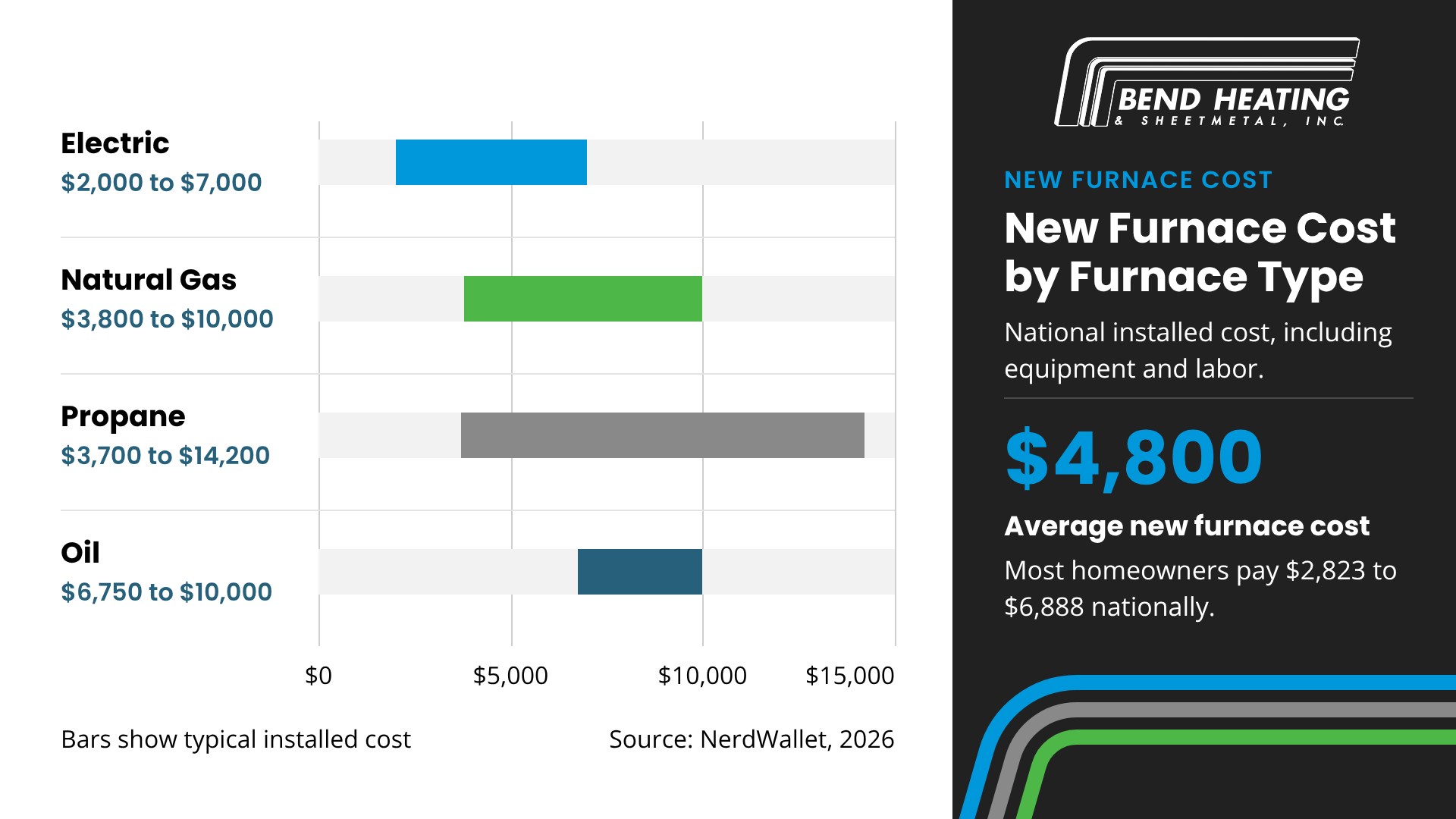
These are national figures that include the equipment and professional installation. In Central Oregon, Bend Heating’s estimators review your home’s needs and may offer up to three options, though often only one is needed. Gas furnace replacement pricing typically falls into these tiers:
- Good (80% AFUE): $5,200 to $7,500
- Better (90-95% AFUE): $6,800 to $9,500
- Best (96%+ AFUE): $8,500 to $11,000
Your exact installation cost depends on your home and the factors below, so a free quote is the best way to get an accurate number.
What Affects Furnace Cost
Furnace Type and Fuel Type
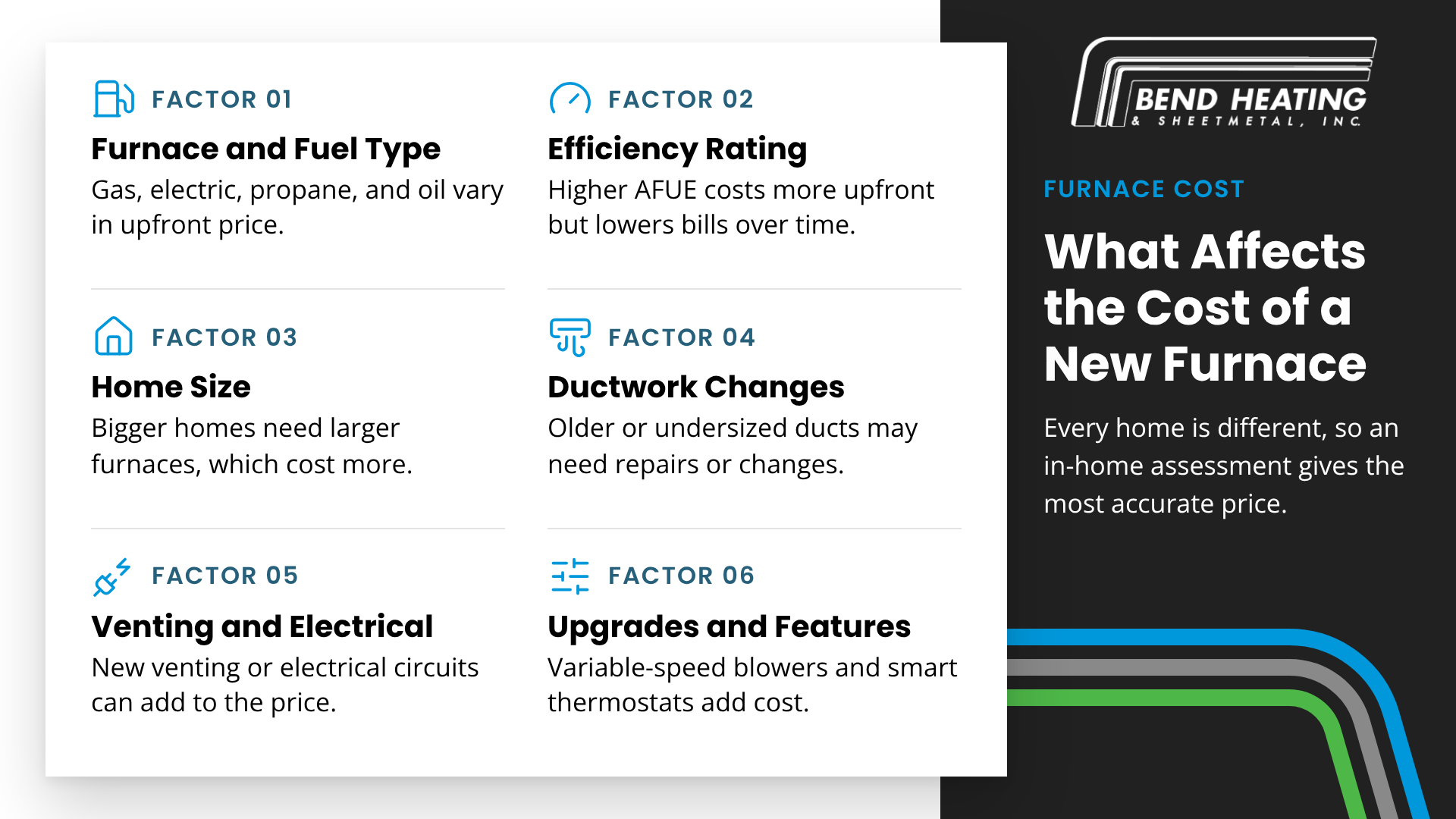
The type of furnace you choose affects both the upfront price and what you pay to run it each winter.
| Type of Furnace | How It Heats | Cost Notes |
| Gas furnace | Burns natural gas | Usually costs more upfront but less to run than electric |
| Electric furnace | Uses electric heating elements | Often simpler to install, but can be expensive to operate |
| Propane furnace | Burns propane from a tank on your property | An option for homes without natural gas service |
| Oil furnace | Burns heating oil from a tank | Heating oil can cost more per year than natural gas |
| Heat pump with electric air handler | Moves heat instead of making it | Can replace a gas furnace in an all-electric home |
If your home already has natural gas, a gas furnace replacement is often the simplest swap. Changing fuel type can add cost because it may mean new gas lines, venting, or electrical connections. Some homeowners pair a heat pump with a gas furnace in a dual fuel system, which uses the heat pump in milder weather and the furnace when it gets very cold.
Efficiency Rating (AFUE)
Annual fuel utilization efficiency (AFUE) shows how much of a furnace’s fuel turns into heat for your home. According to the U.S. Department of Energy, older furnaces run at 56% to 70% AFUE, mid-efficiency models at 80% to 83%, and high-efficiency models at 90% to 98.5%. A higher AFUE rating usually means a higher price upfront and better energy efficiency, which lowers heating bills over time.
Size and Your Home’s Square Footage
Furnace size is measured in British thermal units (BTUs), which show how much heat the furnace can put out per hour. As a rough guide:
- 1,500 to 2,000 square feet: 60,000 to 80,000 BTU
- 2,000 to 2,800 square feet: 80,000 to 100,000 BTU
- Over 2,800 square feet: 100,000 BTU or more
Square footage is only a starting point. Insulation, windows, and ceiling height also factor into how much heat your home needs. Bend Heating uses a load calculation during the in-home assessment to size each new furnace accurately, since a furnace that is too big or too small can waste energy. Larger furnaces usually cost more, so the right size also helps you avoid paying for more than you need.
Installation Complexity
Installation needs are different in every home. Common items that can add cost include:
- Ductwork modifications: Older or undersized ducts may need repairs or changes to work well with a new system, which is an additional cost.
- Venting changes: High-efficiency furnaces typically vent through PVC pipe and need a condensate drain, so replacing an 80% furnace with a high-efficiency model can mean new venting.
- Electrical connections: An electric furnace or heat pump may need new circuits or an electrical panel upgrade.
- Tight spaces: Attics, crawl spaces, and small closets can take more time to work in.
Furnace Brand and Features
The furnace brand and features you choose also affect the price. Upgrades that can raise the cost include:
- Variable-speed blower: Moves air more evenly and quietly through your home.
- Two-stage or modulating burner: Adjusts heat output to match what your home needs, which can mean fewer temperature swings.
- Smart thermostat: A smart thermostat can help manage Central Oregon’s big temperature swings between day and night.
Is a High-Efficiency Furnace Worth the Extra Cost?
For many Central Oregon homes, a high efficiency furnace pays back part of its higher price through energy savings. Bend Heating estimates that upgrading an 80% AFUE furnace to a 96% model saves the average Bend home about $350 per year in gas costs. Over 15 years, that could add up to about $5,250 in long-term savings.
In colder climates like Central Oregon, a furnace runs more hours each year, so the energy savings from a high-efficiency model add up faster. If you are planning to move soon or need to keep the upfront price as low as possible, a standard 80% furnace can still be a reasonable choice. A high-efficiency model often makes the most sense when:
- You plan to stay in your home for several years
- You are replacing an older furnace with a low efficiency rating
- You qualify for incentives that lower the upfront price
Ways to Finance a New Furnace

Monthly Payment Plans
Bend Heating offers HVAC financing through Synchrony Bank, with repayment plans of 6, 12, 18, or 25 months. There is no interest if you pay the full balance within your plan’s term. Seasonal financing promotions through Carrier and Wells Fargo are also available and change each year. Reach out to our team to learn about this year’s offers. The process is simple:
- Get an installation quote from Bend Heating.
- Apply for financing through Synchrony Bank.
- Choose your repayment term once you are approved.
Energy Trust of Oregon Incentives
Some homeowners may qualify for Energy Trust of Oregon incentives on qualifying high-efficiency equipment. Incentives depend on your utility and the system you choose, and programs change, so check current offers before you buy. Bend Heating’s team can recommend systems that qualify and guide you through the process.
Manufacturer Offers
As a Carrier Factory Authorized Dealer, Bend Heating can offer Carrier’s Cool Cash incentives on qualifying equipment. These offers change throughout the year, so ask about current Cool Cash promotions when you get your quote.
Frequently Asked Questions
How long does furnace installation take?
The installation itself usually takes one day. The full process, including the in-home assessment and the install itself, often takes about one to two weeks, since Bend Heating handles permits with the City of Bend or Deschutes County and orders equipment before install day. If your home has no heat, we can install a new furnace the next day.
Should I repair my older furnace instead of replacing it?
It depends on the repair. If a repair would cost more than half the price of a new furnace, replacement usually makes more financial sense. Frequent repairs on an older furnace are another sign it may be time to replace it. Reach out to our team for a free quote if you are unsure about which steps to take.
Is an electric furnace cheaper than a gas furnace?
An electric furnace often costs less to install, but it can cost more to run than a gas furnace. A heat pump can be a more efficient electric option for many homes.
Get an Honest Quote From Bend Heating & Sheet Metal
Nationally, most homeowners pay about $4,800 for a new furnace, and the final price depends on the furnace type, efficiency rating, size, and installation needs. A high-efficiency furnace costs more upfront but can lower your heating bills, plus financing and incentives can make the price easier to manage. Every home has different installation requirements, so an in-home assessment gives you the most accurate price and shows which option saves the most in the long run.
Bend Heating & Sheet Metal has helped Central Oregon families with heating and cooling since 1953. Our NATE-certified team gives expert guidance on the right furnace for your home and budget. As a Carrier Factory-Authorized Dealer, we install gas and electric furnaces, help you check for Energy Trust of Oregon incentives, and offer flexible financing.
We serve Bend, Redmond, Sisters, Sunriver, Prineville, and La Pine. Request a free quote or call (541) 382-1231 to get started.
 CALL US
 TEXT US