
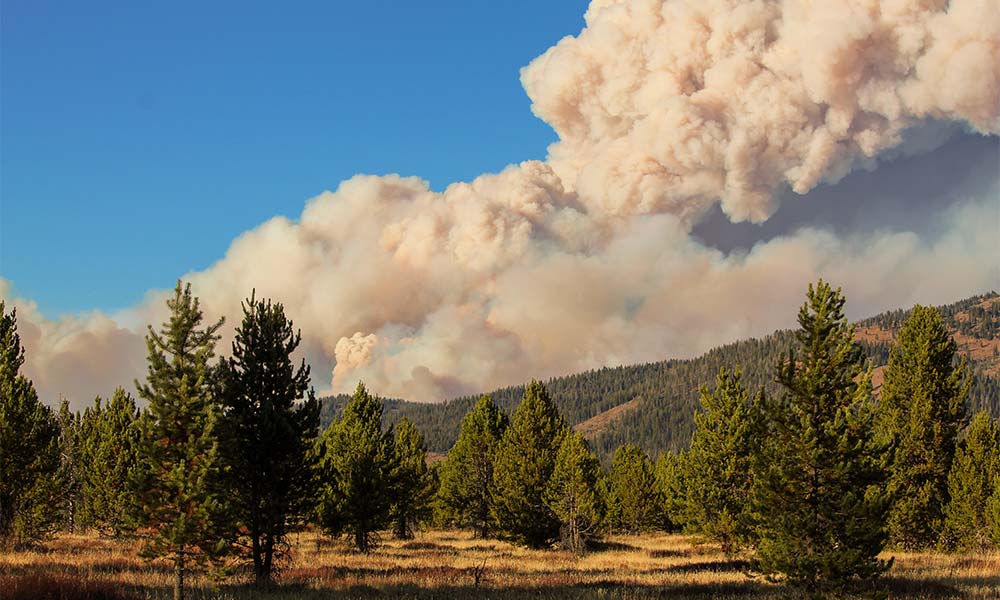
When wildfire smoke settles over Central Oregon each summer, indoor air quality becomes a real health concern for Bend families. Smoke particles are small enough to work their way into homes, and the systems meant to keep you comfortable can either help filter that air or, if they’re not set up right, pull smoke inside. Knowing how to use your HVAC system during smoke events makes a meaningful difference in the air your family breathes.
Since 1953, Bend Heating & Sheet Metal has helped Central Oregon homeowners keep their homes comfortable through every season — including our increasingly smoky late summers. Here’s how to protect your indoor air quality when wildfire smoke rolls in.
How Wildfire Smoke Gets Into Your Home
Wildfire smoke is made up of fine particulate matter — particles small enough to slip through gaps around windows, doors, and through ventilation systems. During heavy smoke events in Central Oregon, outdoor air quality can reach unhealthy levels for days at a time, and without the right precautions, indoor air quality follows.
Your HVAC system plays a central role here. It can be one of your best tools for cleaner indoor air, or a pathway that brings smoke inside — it depends on your filtration and how you run the system.
Upgrade Your Air Filter
Your filter is the first line of defense against smoke particles, and not all filters are equal.
Filters are rated by MERV (Minimum Efficiency Reporting Value). Higher MERV ratings capture smaller particles:
- MERV 8-10: Standard filtration, captures larger particles like dust and pollen
- MERV 11: Better filtration that captures finer particles, including much of what’s in wildfire smoke — a strong choice for most Central Oregon homes
- MERV 13: Higher-efficiency filtration, but only appropriate if your ductwork can handle it
Here’s something a lot of homeowners don’t realize: a higher MERV number isn’t automatically better. The thicker and denser the filter, the more it restricts airflow — which increases static pressure on your system. High static pressure is one of the hardest things on an HVAC system and can lead to bigger problems down the road. For that reason, we typically recommend going no higher than MERV 11 unless your ductwork is designed to handle a denser filter. Our technicians can tell you what your specific system can support.
During smoke season, check and change your filter more often than usual. Smoke loads filters quickly, and a clogged filter can’t protect your air or your equipment.
Run Your System Fan for Continuous Filtration
One of the simplest and most effective things you can do during a smoke event is set your thermostat fan to “ON” rather than “AUTO.”
On “AUTO,” the fan only runs when your system is actively heating or cooling. On “ON,” the fan runs continuously, which means air keeps cycling through your filter around the clock — continuously pulling particles out of your indoor air rather than only when the system calls for cooling. Paired with a quality filter, continuous circulation noticeably improves the air in your home during smoke events.
Keep Smoke Out: Seal and Recirculate
During heavy smoke, the goal is to filter the air already inside your home rather than pull more smoky air in from outside.
- Keep windows and doors closed during smoke events, even on cooler evenings when you’d normally air out the house
- Run your air conditioning to stay comfortable without opening up — modern systems recirculate and filter indoor air rather than drawing in outdoor air
- Seal obvious gaps around windows and doors where smoke can infiltrate
- Create a clean room if smoke is severe — one room with a portable air purifier where your family can spend time in cleaner air
Why Ductless Systems Offer an Air Quality Advantage
Ductless mini-split systems offer a filtration advantage during smoke season. Each indoor unit has its own multi-stage filtration, and because you can run individual units, you can maintain cleaner, cooler air in the rooms your family uses most — like bedrooms during smoke events — without conditioning the whole house.
For homes that struggle with air quality during fire season, ductless systems provide both targeted comfort and an extra layer of filtration where it matters most.
Consider Whole-Home Air Filtration
For homeowners who want stronger protection, whole-home air filtration systems integrate directly with your HVAC system to filter all the air circulating through your home. These systems capture finer particles than standard filters and require less frequent maintenance during smoke season.
Whole-home filtration is especially worth considering for households with children, older adults, or anyone with respiratory conditions or sensitivities, where air quality has a direct impact on health and comfort.
When to Call a Professional
If you notice any of the following during smoke season, it’s worth a professional assessment:
- Your system struggles to maintain airflow with a high-efficiency filter installed
- You want to upgrade to whole-home filtration before or during fire season
- Your home has persistent air quality issues even with windows closed and the system running
- You’re considering a ductless system for better room-by-room filtration
Breathe Easier This Wildfire Season
Central Oregon’s wildfire seasons aren’t going away, but with the right filtration and a few smart habits, you can keep your home a comfortable, cleaner-air refuge when the smoke rolls in.
For help improving your home’s air quality — from filter upgrades to whole-home filtration and ductless options — call Bend Heating & Sheet Metal at (541) 382-1231. Our certified technicians serve Bend, Redmond, Sisters, Sunriver, and surrounding Central Oregon communities, and we can recommend the right air quality solution for your home and system.
Serving Central Oregon since 1953. Licensed, experienced, and here to help your family breathe easier.
 CALL US
  TEXT US